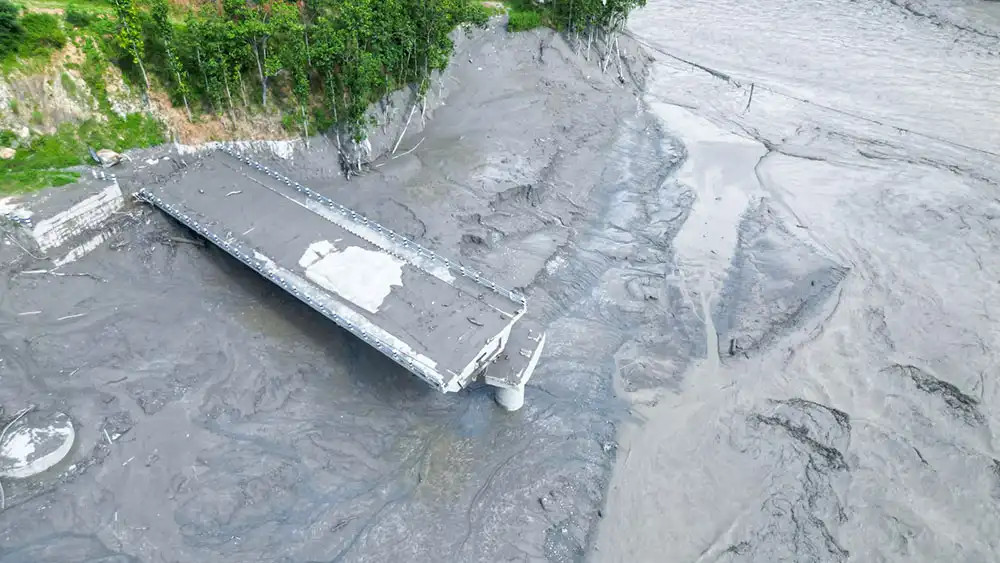
The devastating flood that struck the Rasuwagadhi border point last Wednesday has dealt a major blow to Nepal’s festival-season supply chain, sweeping away around 200 cargo containers carrying goods destined for the domestic market.
The destroyed shipments included apparel, footwear, electronic goods and fresh fruits-items that traders had stocked ahead of the country’s biggest festive season, including Dashain and Tihar.
With the Tatopani border crossing also remaining indefinitely closed, traders face a growing supply crunch and sharply higher transportation costs. Market prices of several imported goods could rise by as much as 20 percent, traders warn, as businesses struggle to bring supplies into Kathmandu through alternative routes.
Alternative routes push transport costs sharply higher
The disruption at Nepal’s northern border points has forced traders to look for longer and more expensive alternatives. Cargo that would normally enter Nepal through Tatopani is now being diverted through the Korala border. The alternative route significantly increases both transportation time and cost.
According to traders, transporting goods from Korala to Kathmandu can take six to 10 days, compared with roughly one day through Tatopani under normal conditions.
The shortage of available vehicles has further aggravated the problem. Freight container charges that previously ranged between Rs. 175,000 and Rs. 200,000 have surged to approximately Rs. 300,000–400,000.
For importers already dealing with damaged inventory and disrupted supply chains, the additional logistics burden could ultimately be passed on to consumers.
Sea freight offers no immediate solution
Traders cannot easily turn to sea freight to compensate for the disruption either. Cargo transported overland from China to Nepal generally takes around 12–13 days, while shipments arriving through sea routes can take 55 to 65 days.
With Dashain and Tihar approaching, goods ordered through sea freight at this stage are unlikely to reach the Nepali market before the major autumn festivals are over. This leaves importers with limited short-term options at a time when demand traditionally rises sharply.
More than Rs. 2 billion in cargo damage
The financial impact of the disaster extends well beyond the physical destruction of containers. Preliminary estimates from the Nepal Trans-Himalayan Border Commerce Association put the value of damaged cargo at more than Rs. 2 billion. Individual containers are estimated to have carried goods worth between Rs. 5 million and Rs. 20 million.
The disaster has also created a significant impact on government revenue. Importers had reportedly already paid between Rs. 170 million and Rs. 180 million in customs duties on the shipments that were subsequently lost. The destruction therefore represents not only a direct loss to traders but also a loss of economic activity and potential revenue across the supply chain.
Hundreds of containers stranded, perishable goods at risk
The disruption is continuing on the Chinese side of the border. According to the association, 176 Nepal-bound containers remain stranded at Kerung, while only 74 drivers are currently available to transport the cargo.
The situation is particularly critical for perishable goods such as fruits. Prolonged delays could result in substantial spoilage, adding another layer of losses for traders. The disaster has also taken a severe human toll.
The association says 76 people affiliated with the trading community remain missing following the floods. For families and businesses already struggling with the loss of goods, the disappearance of traders and transport workers has compounded the financial and emotional distress.
Many affected traders had financed their imports through bank loans, meaning the destruction of inventory could leave them facing repayment obligations without the underlying goods or expected sales revenue.
Traders seek immediate diplomatic intervention
The Nepal Trans-Himalayan Border Commerce Association has called on the government to take urgent diplomatic initiatives to restore cross-border trade. Association President Ram Hari Karki has urged the Nepali government to engage in bilateral discussions with China and seek the immediate reopening of the Tatopani border crossing.
He has also proposed developing the Lamabagar crossing in Dolakha as a long-term alternative to reduce Nepal’s dependence on a limited number of northern trade routes. The proposal comes amid growing recognition that Nepal’s northern supply chains remain highly vulnerable to natural disasters and disruptions at individual border points.
Trade association postpones elections
The disaster has also disrupted the association’s own institutional activities. The association has indefinitely postponed its general assembly and leadership elections, which had originally been scheduled for late August or early September. Instead, its immediate focus has shifted to search, rescue and relief operations following the floods.
For traders, however, the challenge extends beyond the immediate rescue effort. The destruction at Rasuwagadhi, combined with the closure of Tatopani, has exposed the fragility of Nepal’s festival-season supply chain and its heavy dependence on a handful of cross-border corridors.
As the country approaches Dashain and Tihar, the consequences could increasingly be felt not only by importers and transporters but also by ordinary consumers through higher prices, fewer choices and delayed supplies.
The immediate priority is restoring trade routes. But the larger lesson is harder to ignore: Nepal needs a more diversified and resilient cross-border logistics network if disruptions at a single border point are not to ripple through the entire economy.











प्रतिक्रिया दिनुहोस